
You finish the handshake line. no matter what.
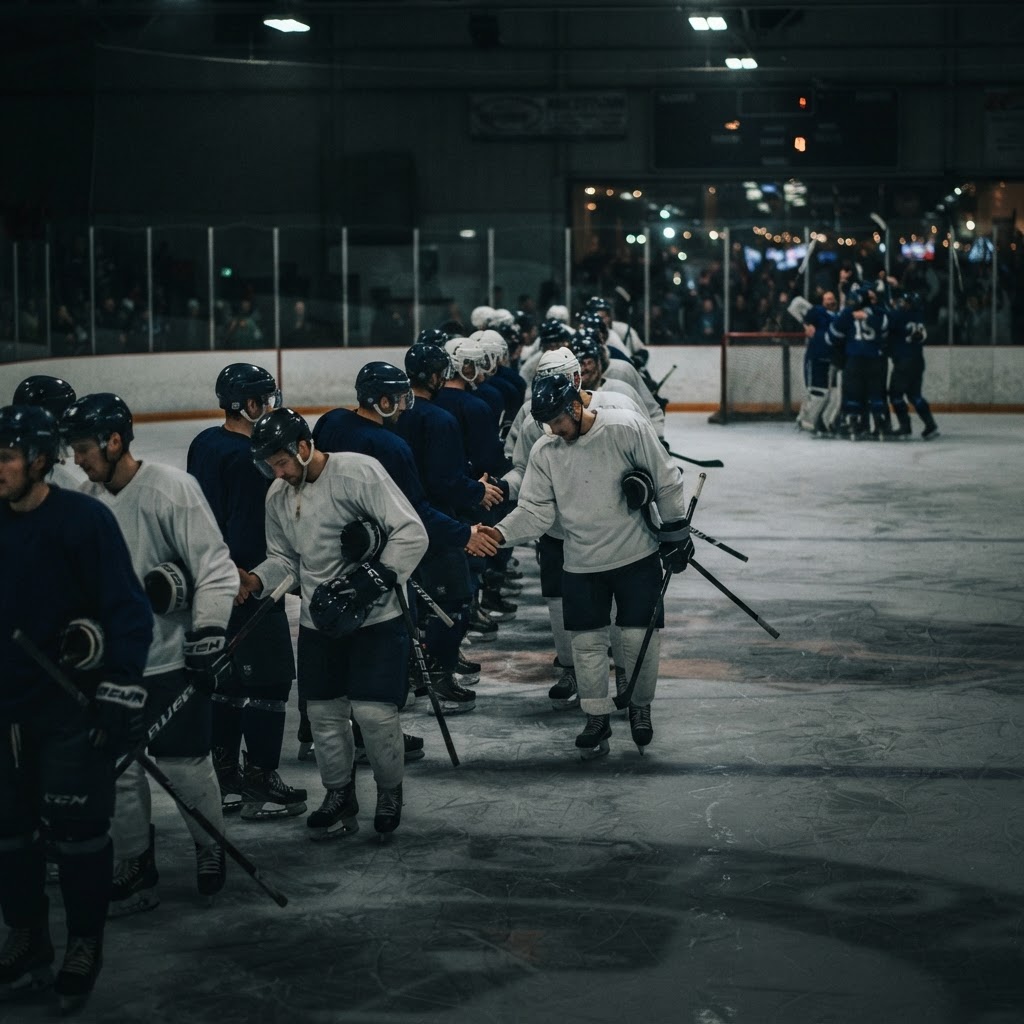
There's a moment, right after the final buzzer of a playoff series, where everything goes quiet inside a player's chest. The winning team is losing their minds on the ice. The losing team is standing there in that specific kind of stillness that only comes from elimination. And then, one by one, they move toward each other.
No one tells them to. There's no official rule that says you have to do it. The NHL doesn't fine you if you skip it. And yet — you do it. You've always done it. You'll always do it. Because the handshake line isn't a rule. It's something older than that.
It's one of the last things in hockey that hasn't been coached, corporatized, or turned into content. And the code around it is more complex than people outside the game will ever understand.
What the Line Is Actually For
People who don't play the game see the handshake line and think it's sportsmanship. A nice gesture. A Hallmark moment.
That's not what it is.
The handshake line is accountability. It's the moment where you have to look the guy you've been battling — sometimes literally fighting — directly in the eye and acknowledge what just happened. You can't hide in the locker room. You can't skate off the other side of the ice. You line up, you go through, and you face it.
For the winners, it's a moment of restraint. You just won. Your whole body wants to explode. But you dial it back, because gloating in the line is one of the most disrespectful things you can do in hockey. You say "good series," you mean it, and you move. If you slow down too long over a guy you lit up all series, everyone in the building knows what you're doing. Your teammates know. His teammates know. You know.
For the losers, it's harder. That's the thing nobody talks about. Walking into that line after being eliminated — especially after a long series, especially when you thought you had it — takes something out of you that the game never fully gives back. Your legs are empty, your chest is hollow, and you have to shake hands with the guy who just ended your season. Maybe the guy who scored the series winner. Maybe the guy who ran your best player in game four.
You do it anyway. That's what the line is for.
The Unwritten Rules Within the Unwritten Rule
Here's what nobody ever writes down but every serious hockey player understands instinctively:
You don't linger. You don't make speeches. Brief eye contact, firm grip, something short — "good series," "hell of a battle," "good luck in the next round" — and you keep moving. The line flows. If you've got something genuine to say to one specific guy, you find a moment, but you don't hold up the line to have a conversation.
You don't skip guys. Every player on that ice goes through the full line. Doesn't matter how much bad blood there is. Doesn't matter what happened in game six. You skip someone and you've said something that cannot be unsaid — not just to him, but to everyone watching. Fans notice. Players definitely notice.
You don't celebrate in the line. This one burns people more than anything. If you tap a guy on the helmet like you're congratulating a kid at a birthday party, you're not being friendly — you're being condescending. The guys who've played know the difference. Keep it level.
And if there's real hatred between two players — genuine, accumulated, earned hatred — the handshake between them carries more weight than any other moment in the series. Sometimes they say nothing. Sometimes they say everything. Either way, it matters.
What Happens When Someone Breaks the Code
It doesn't happen often. But when it does, the hockey world reacts with a specific kind of disgust that doesn't exist for other violations of the code.
A blown hit, a dirty play — those get punished in the moment or in the next shift. But skipping the handshake line, or going through it wrong, lives forever. Players remember it. They tell the story. It follows a guy the way few things in hockey actually follow a guy.
There have been moments — even at the NHL level — where a player clearly checked out of the line early, or where body language communicated contempt rather than respect. Those moments get replayed. Analysts pick them apart. Other players comment. Because the line is sacred in a way that's hard to explain unless you've stood in it.
The inverse is also true. When two players who've been at war all series — genuinely hostile, borderline dangerous — come together in the line and handle it with class, that gets remembered too. There's a kind of respect that only forms between people who've competed at their absolute limit against each other. The handshake is where that gets acknowledged. Quietly, briefly, but completely.
Beer League Has the Line Too. Don't Laugh.
This isn't just an NHL thing. This isn't just for players chasing championships.
The Sunday night beer league playoff, final game of the season, your team just dropped a heartbreaker in overtime against the guys you've been talking trash to all winter — you still line up. Guys who are already thinking about cold ones in the dressing room still go through the line with intent.
Because somewhere along the way, whether you played AAA or never made it past house league, you absorbed the code. You understand what the line means. And you know that how you conduct yourself in it says something about you as a player that doesn't change based on the level you play at.
Some of the most genuine handshake moments happen in beer league, actually. Two guys who genuinely disliked each other all season, who maybe took some runs that went a bit far, who said things they maybe shouldn't have — they shake hands and sometimes something gets cleared. The game absorbs it. The line closes it out.
That's the beauty of the code at this level. Nobody's making money. Nobody's going to the show. And yet the ritual holds because the ritual has value independent of the stakes.
The Characters Who Teach You What the Line Means
Every player who's been in the game long enough has a memory of someone who showed them what the handshake line is supposed to look like.
Maybe it was a veteran on your junior team, age-out year, eliminated in the first round, clearly devastated — and he went through that line with more composure and more genuine respect than anyone. You watched him and you filed it away. That's how you do it.
Maybe it was the opposite — a guy who made a scene, who made it about himself instead of about the game, and the way your locker room talked about it afterward stuck with you. That's how you don't do it.
The dressing room is where the code gets passed down. Not from coaches giving speeches, not from rule books, not from parents in the parking lot explaining sportsmanship. From older players modeling it, and from the room's collective response when someone gets it wrong. You learn by watching. You teach by doing.
That's the whole mechanism of the unwritten rules — not enforcement from above, but pressure from within. The room polices itself. The code sustains itself.
After the Line, the Season Ends
For the losers, the handshake line is the last official act of the season. After that comes the quiet skate back to the bench, the long walk to the locker room, the gear coming off for the last time this year. The silence in there is a specific kind of silence that you carry with you.
For the winners, the line is a transition point — you've acknowledged your opponent, now you can let it go. Now you can celebrate. The line gives you permission in both directions.
And for everyone who's ever played, the handshake line is one of those things that proves hockey has something the other sports don't fully have. A culture of accountability that runs all the way down from the NHL to the 10:45 PM Sunday slot at your local barn. A shared understanding that how you compete matters, but so does how you finish.
You finish the handshake line. No matter what. Because the game demands it, and because somewhere deep in the code, you already knew that before anyone ever told you.
From the Collection
The Hard Around tee is built for people who understand the code. Available now at /product/472184482.
Explore the drop →