
What the Coach Knows That Nobody Else Does
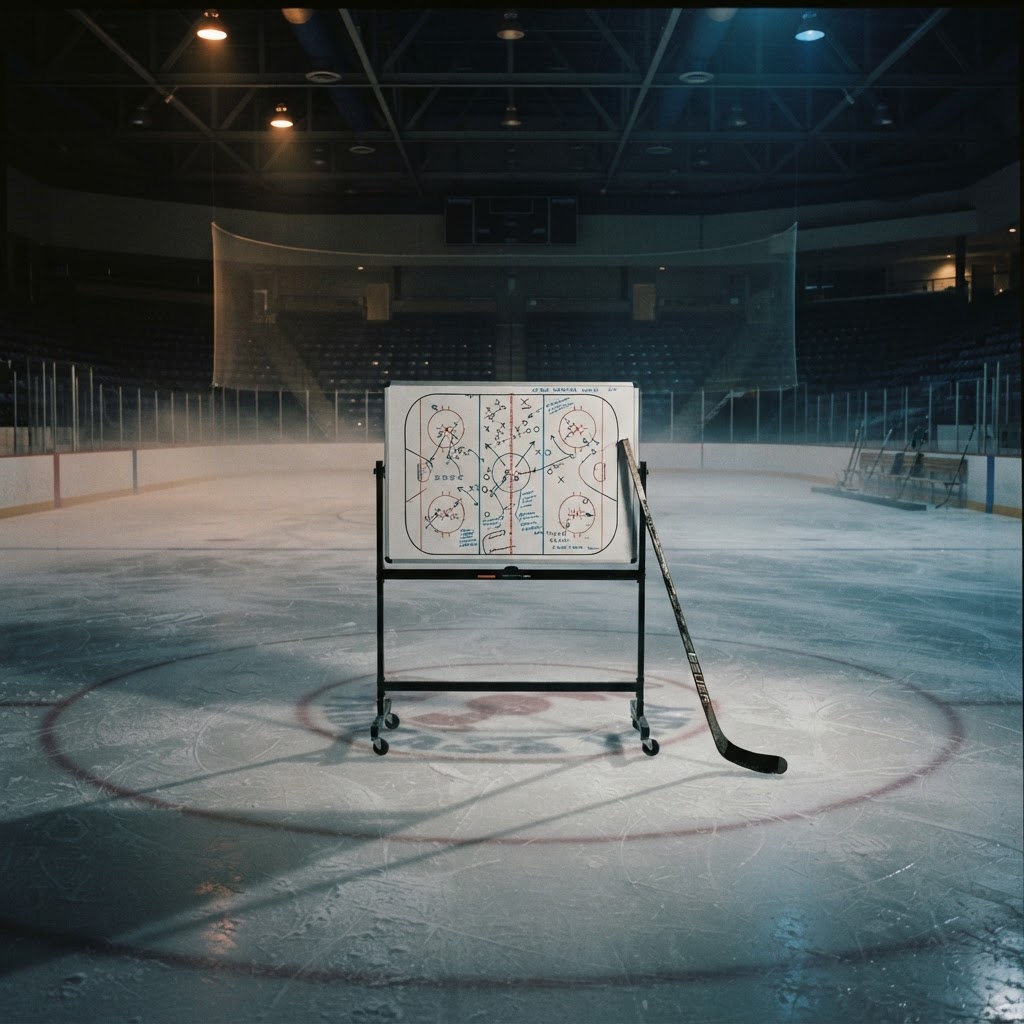
There's a moment in every practice where the coach just stops. Blows the whistle, lets the drill die, and stands there at centre ice holding the puck. Nobody moves. You can hear the hum of the refrigeration system. And then, without raising their voice, they say something that cuts right through the noise.
That moment doesn't come from a coaching manual. It comes from years of reading rooms, reading people, and understanding that hockey is never just about hockey.
The coach is the most misunderstood person in the rink. The parents think they know what the coach is doing wrong. The players think they know what the coach doesn't see. What nobody really understands is how much the coach carries — and how much of the job happens in the five minutes before the team shows up and the ten minutes after they leave.
The Whiteboard Is a Lie
Every coach has a whiteboard. Xs and Os, breakout patterns, power play setups, neutral zone traps that look brilliant in marker and fall apart the second a sixteen-year-old touches the puck. The whiteboard is where the plan lives. The ice is where reality lives.
The best coaches understand this instantly. The whiteboard is a communication tool, not a gospel. It's how you get fifteen people looking at the same thing for thirty seconds so you can actually talk to them. The real coaching happens in the adjustments — in reading what's broken, understanding why, and fixing it without making anyone feel like they blew the whole system.
New coaches fall in love with their own diagrams. Veteran coaches know that most of what you draw gets erased by the first defensive zone turnover. What survives is structure, habits, and the ability to make decisions under pressure. You can't draw that on a whiteboard. You build it over a thousand reps and a hundred honest conversations.
Reading the Dressing Room Before the First Shift
The coach who walks into a dressing room and just talks is the coach who doesn't actually coach. The ones who last — the ones players remember for the rest of their lives — they walk in and listen first. They scan the room. Who's too quiet? Who's too loud? Who's sitting in the corner with their helmet already on at the wrong kind of focused?
A dressing room tells you everything if you know how to read it. There are nights where the energy is right and you barely have to say a word. And there are nights where you can feel the flatness in the air — guys going through motions, nobody making eye contact — and you know before puck drop that something needs to shift.
The pre-game talk is one of the most misunderstood pieces of coaching. It's not a speech. It's a recalibration. You're not firing people up with words like you're in a movie. You're taking fifteen individuals who walked in from fifteen different days and reminding them that for the next two hours, they're one thing together. The good coaches can do that in four sentences. The bad ones ramble for eight minutes and lose the room by minute two.
Managing the Player Who Thinks They Should Be Playing More
Every coach, at every level, from novice house league to junior A, has one. The player who absolutely believes — with total conviction — that they should be getting more ice time, a spot on the top line, a power play unit, more zone starts. And sometimes they're right. But usually they're not, and the conversation is the same regardless.
This is where coaching gets genuinely hard. Because how you handle that player determines the health of the whole locker room. Give in and you've signalled to every other player that complaining works. Dismiss them and you've lost them — their engagement, their effort, and eventually their presence on the team.
The coaches who navigate this well have a specific skill: they separate the emotion from the information. They acknowledge what the player is feeling without validating the conclusion. They give honest, specific feedback — not vague encouragement, not brutal criticism. They tell the player exactly what they need to see to earn what they're asking for. And then they hold to it, publicly and privately, without wavering.
That consistency is everything. Players don't need a coach who tells them what they want to hear. They need one who tells them the truth in a way they can actually use.
The Classic Sayings and What They Actually Mean
Every hockey coach has a collection of lines they cycle through like a playlist. Some of them are so worn they barely register anymore. *Play your game. Fifty-fifty pucks. Simple is fast. One shift at a time.* You've heard them all. You've tuned most of them out.
But here's the thing — most of those sayings are genuinely correct. They're just delivered so often they stop landing. The best coaches know how to weaponize the cliché, which means using it sparingly enough that when it comes out, it still means something.
*Pucks don't lie* is the most honest three words in coaching. Box scores, shift charts, zone time — these aren't insults. They're feedback. The coach who leans on that knows that arguing about effort is subjective. Arguing about results is simple.
*Play for each other, not for the scouts* — said at every junior tryout, every showcase weekend, every tournament with a few extra faces in the stands. And almost nobody actually does it. The coaches who say it and mean it build teams that are genuinely harder to play against. The coaches who say it and then scratch the kid who played team hockey while rewarding the one who dangled into three guys — they lose the dressing room before Christmas.
The Coach Nobody Talks About: The One Who Stayed
There is a specific type of coach that doesn't get celebrated enough. Not the one who moved up the ranks, took the AAA job, made it to juniors. The one who stayed. Fifteen seasons in the same minor hockey association, same cold arena, same underfunded dressing room with the one shower that barely works. The one who coached your dad and then coached you and is now coaching your kid.
Those coaches hold entire communities together and nobody throws them a banquet. They know every family on the team — not just the player's name, but the home situation, the school situation, the stuff that doesn't show up in the registration form. They adjust their coaching to protect kids who need protection and challenge the ones who need pushing. They do it without making it a big deal, because it isn't a big deal to them. It's just the job.
When those coaches retire — and eventually they all do — the hole they leave is enormous and usually invisible. Another coach steps in, does their best, and the kids adapt. But something specific disappears with that person. An institutional memory. A relationship with the game that took decades to build.
Those are the coaches worth remembering. The ones who could have left and didn't.
What Coaching Actually Teaches You About People
Ask any retired coach what they learned from thirty years behind the bench and almost none of them lead with hockey. They talk about people. About patience. About how wrong you can be about someone in the first week and how right they can prove you wrong by the end of the season.
Coaching teaches you that confidence and arrogance are genuinely different things and you need to nurture the first one carefully because it's fragile in most players even when it doesn't look like it. It teaches you that the kid who seems like the problem is usually the symptom of something else. It teaches you that winning fixes very little and losing reveals almost everything.
It teaches you that the game is bigger than the game. Always has been. The ice is just where it happens to live.
And somewhere in all of it — the early mornings, the long bus rides, the conversations after practice that stretch well past when anyone planned to stay — coaches figure out that the job was never really about hockey at all. It was about people becoming something together. The hockey was just the reason they showed up.
From the Collection
The Hard Around Coach Cap fits the person who's been behind the bench since before it was cool. Simple, no fuss, built for the rink. Find it at /product/472152300.
Explore the drop →