
The Two Hours Before Puck Drop Are Sacred
There's a version of hockey night that starts when the puck drops. That version is wrong.
The real thing starts hours earlier. It starts with a text thread that's been going since Tuesday. It starts with you checking the bag you already checked twice. It starts with that specific low-grade buzz in your chest that doesn't have a name but every hockey person knows exactly what it feels like. By the time you're lacing up, you're already deep into it.
We spend a lot of time talking about the game itself — the goals, the hits, the overtime moments that make grown adults lose their minds in a cold arena at 10 PM on a Wednesday. But the culture around hockey night? The hours before the drop? That's where the real texture lives. That's the stuff worth talking about.
The Text Thread Is Its Own Event
It usually starts the morning of. Someone fires off something dumb — a meme, a trash talk opener, a reminder about who owes who from last week's loss. By noon it's a full group chat disaster. Lineup changes, gear updates, someone's running late, someone's always running late, and at least one person is asking what time warm-up starts even though it hasn't changed in three years.
The text thread is chaotic and it's perfect. It's how the group collectively gets its head into the game. You're not just coordinating logistics — you're building the energy together before anyone's even touched a skate. By the time you're pulling into the rink parking lot, you've already been mentally in it for hours.
There's a social architecture to these threads that nobody designed on purpose. The guy who sends the first message sets the tone. The quiet guy who only shows up with fire takes on a certain legendary status. The person who texts "gl hf" unironically gets chirped until the end of time. It's a whole ecosystem, and it's been running on every team in every city since the first person got a cell phone and a hockey schedule.
The Drive to the Rink
This is underrated. The drive to the rink has a different energy depending on whether you're going to watch or going to play, and both are excellent in their own right.
If you're playing, there's a quiet focus that sets in around the halfway point. The playlist shifts. The small talk fades. You start running through systems in your head even though you'll immediately forget them the moment you hit the ice and chaos takes over. The rink parking lot — usually half-empty, always a bit grim — feels significant in a way that grocery store parking lots never do.
If you're going to watch, the energy is looser but still deliberate. There's a stop to make. Tim's, a corner store, someone's apartment first for the pre-game setup. The route matters. The ritual of the route matters. You don't deviate from the route.
Either way, the drive to the rink is when hockey night stops being a calendar event and starts being real. Something shifts on that drive. People who've never played a game in their lives and just love watching still feel it. That transition — from regular Tuesday to hockey night — happens somewhere on that road.
Getting Dressed Is a Ceremony
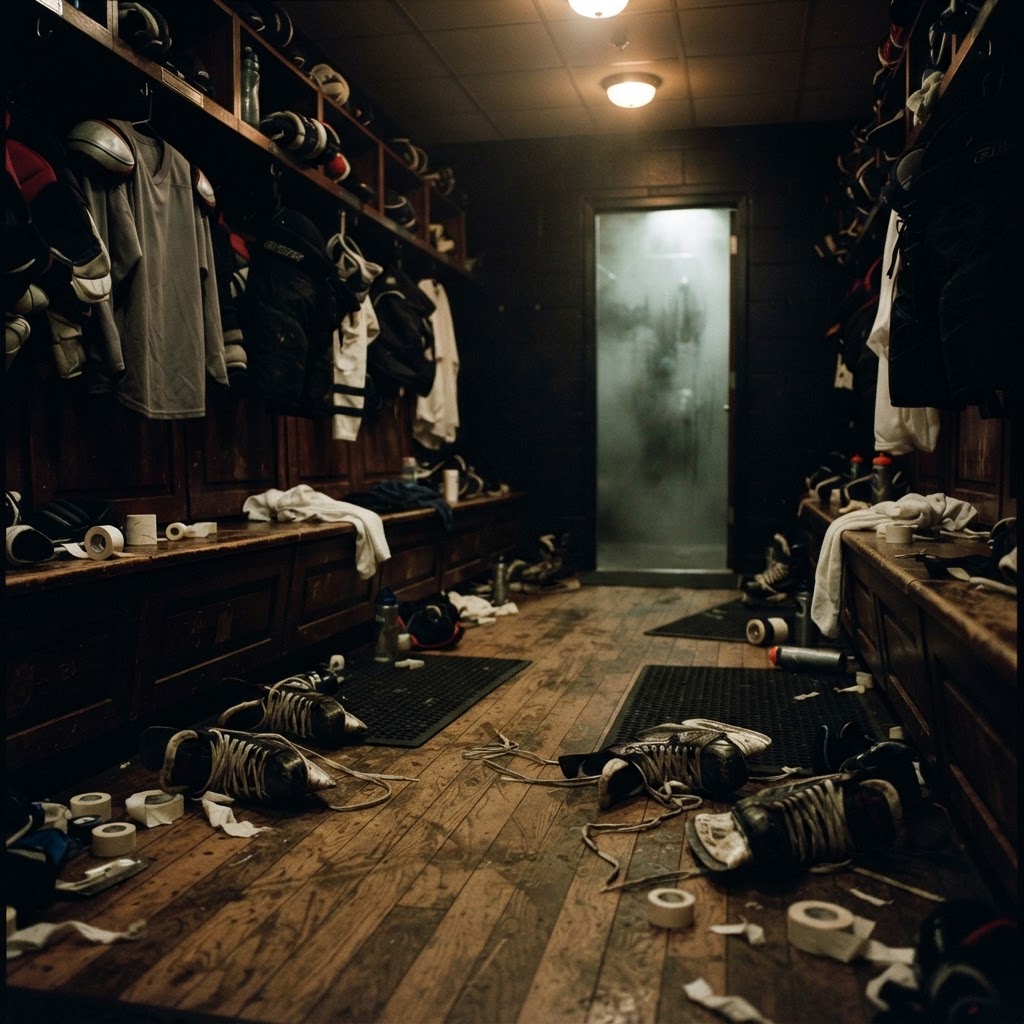
The dressing room before a game is one of the most specific social environments on earth. The smell alone could be bottled and sold as nostalgia. Tape, rubber, sweat absorbed into wooden benches over decades of use. The low-grade chaos of fifteen people getting dressed in a space designed for twelve. Someone's music is too loud, someone's complaining about the music, and somehow it all works.
But there's an order to it. Not a written order, not a rule anyone explained — just an order that exists because it's always existed. Where you sit. What you put on first. The tape job that takes three times longer than it should because it has to be right. Nobody rushes the tape job. You could be ten minutes from warm-up and the tape job still takes as long as the tape job takes.
Watching players has its own pre-game dressing ritual too, even if the dressing room is your living room or a bar. The jersey goes on at a specific time. Not too early — that's bad energy — but not at puck drop either. There's a window. Everyone who's superstitious about it knows the window, even if they've never articulated it out loud.
The Food Situation
Hockey night food is a whole separate conversation that deserves more respect than it gets. We're not talking about arena concessions — though the arena hot dog at 9:30 PM hits in ways that are genuinely difficult to explain to non-hockey people. We're talking about the full ecosystem.
The pre-game meal for players is serious business. Pasta at 5 for a 7:30 puck drop. The specific restaurant that became the pre-game spot because someone suggested it once three seasons ago and now it's law. The superstition around eating the same thing before a win streak and the quiet devastation when you break it and lose.
For watch parties, the food is part of the ceremony. Wings that arrive in the second period because you timed the order wrong. Pizza that nobody ordered but somehow appeared. The elaborate chip-and-dip setup that one person in the group always shows up with, every single time, and nobody ever acknowledges it but everyone would notice if it wasn't there.
Food at hockey night isn't just sustenance. It's timing, it's rhythm, it's part of the structure that makes the night feel like the night it's supposed to be.
The Jersey Discussion
At some point during the pre-game build-up, someone brings up what they're wearing. This is unavoidable.
For a watch party, it matters more than you'd think. There's the debate about whether wearing a player who got traded is still okay (it is, but it requires a brief disclaimer). There's the person who shows up in the away jersey and has to defend that choice. There's the friend who doesn't own a jersey but shows up in team colors and that's accepted but noted.
For playing, the jersey debate is about the team set — who's got theirs, whose is at home in a pile of laundry, whether you're going dark or light. The visual identity of a hockey team, even a rec league team, matters to the people in it. The jersey means something. It marks the transition from civilian to player in a way that a t-shirt never could.
The gear and the clothing around hockey night carry a weight that's hard to articulate if you didn't grow up in it. What you wear signals your relationship to the game — how seriously you take it, which era you came up in, what team shaped your earliest memories. You can read a lot about a person from what they show up in on hockey night.
Puck Drop
And then, finally, it happens. All the build-up, all the texts and tape jobs and food orders and jersey debates — they all funnel into this single moment. The puck drops and the game takes over.
But here's the thing: the game couldn't hit as hard as it does without everything that came before it. The ritual creates the meaning. The build-up is what makes the moment. Every superstition, every specific pre-game habit, every dumb argument in the group chat — it's all load-bearing. It all holds up the experience.
Hockey is unique in the level of ritual its culture has built around the actual game. Other sports have fans and traditions, sure. But hockey people — players and watchers both — build entire architectures of habit around the game. The ice time is the destination, but the journey is half the point.
Next time you're in that window between the first text of the day and puck drop, pay attention to it. That's not just killing time. That's the culture running exactly the way it was built to run.
From the Collection
The Hard Around gear is built for the hours before and after the game — the parts that don't make the highlight reel. Browse the collection at hardaround.com/product/472049836
Explore the drop →