
The Wooden Stick Never Lied to You
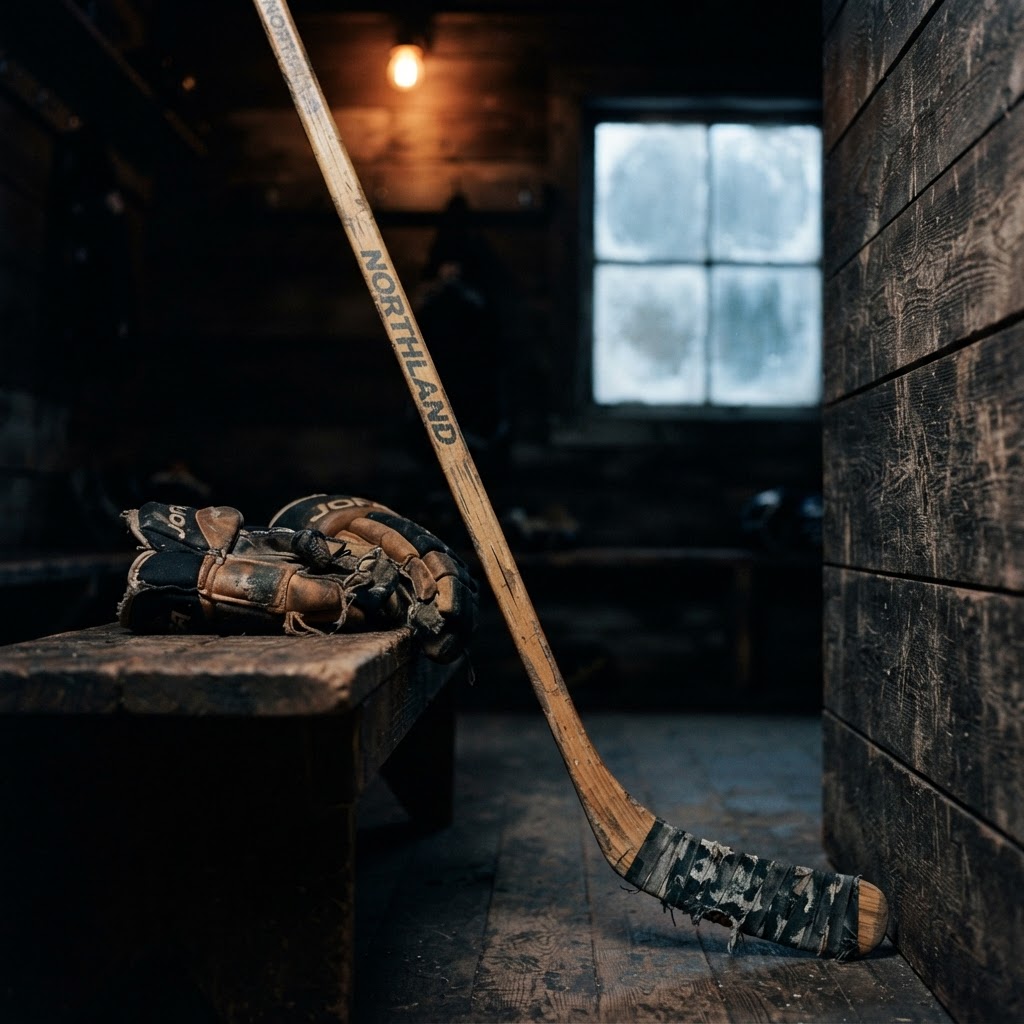
There's a guy in every beer league dressing room who played in the eighties. You know him. He's not bitter about it — he'll be the first to laugh at himself — but at some point in the night, usually after the second period, he'll say something like: *you couldn't hide a bad shot back then.* And everyone in the room who actually listened will nod, because they know exactly what he means.
The wooden stick wasn't just equipment. It was a feedback system. The puck hit the blade and the vibration traveled straight up into your hands and told you the truth. Off the toe, off the heel, mishit, mishit, mishit — the wood knew, and it told you. There was no dampening, no engineering, no composite weave absorbing your mistakes. You felt everything. And somewhere in that feeling, in that raw mechanical honesty, guys learned the game differently.
This isn't about nostalgia for nostalgia's sake. It's about understanding that every era of hockey had its own vocabulary, its own set of physical and cultural truths — and that when the equipment changed, the game changed with it. Not better. Not worse. Just different. Profoundly, permanently different.
When the Blade Was Part of the Player
In the fifties and sixties, you taped your own blade, shaped your own curve — within whatever informal limits your team or your coach allowed — and you played until the stick broke. And it would break. That was a given. You kept a spare behind the bench, leaning against the boards, waiting.
The curve itself was almost a personal signature. Guys like Stan Mikita and Bobby Hull famously experimented with bent blades after accidents bent them accidentally, then noticed what it did to the puck's movement through the air. The innovation wasn't corporate. It wasn't the result of an R&D department. It came from a player fooling around after practice, paying attention, and sharing what he found with someone else who was curious.
That's how the game evolved for most of its early decades — laterally, organically, through players solving problems with whatever they had in their hands. A wooden stick wasn't a product with a marketing campaign. It was raw material you shaped into a tool.
The Rink as a Different Universe
Step back further — into the outdoor rink era, the frozen pond era, the era before Zambonis standardized the ice surface — and you're looking at a version of hockey that barely resembles the modern game in its physical demands. The ice was rough, unpredictable. Pucks bounced. Passes failed. Skating was about survival as much as technique.
And yet those conditions produced some of the most creative players the game has ever seen. Not because hardship breeds greatness in some cinematic way, but because inconsistent ice forces you to improvise constantly. You can't rely on a perfect pass arriving on your tape every time. You develop hands, you develop anticipation, you develop the ability to make something out of nothing.
The atmosphere of that era — wooden boards, dim lighting, the smell of coal-heated change rooms, the sound of blades on rough ice — was its own kind of culture. Players dressed together in rooms that were barely rooms. The game existed in the physical world in a way that feels almost alien now, when arenas are climate-controlled cathedrals and ice quality is monitored by computer.
The Seventies and the Beautiful Chaos
If you want to understand the soul of hockey — the part that gets passed down like folklore — you have to spend some time in the 1970s. Not because the hockey was the cleanest or the most technically refined, but because it was the most honest about what the game actually was.
The WHA years created chaos, and chaos created opportunity. Players who couldn't crack an NHL roster suddenly had somewhere to go. Teams raided each other's rosters. Salaries became real. The monopoly cracked open and for a few years, the game breathed differently.
On the ice, the style was physical to the point of absurdity by modern standards. But watch old footage closely — past the line brawls and the mustaches — and you'll see remarkable skating, genuine creativity in the offensive zone, and a kind of improvisational energy that the more structured modern game has largely traded away for efficiency. The seventies player knew his linemates were going to do something slightly unpredictable. He had to be ready for anything. That readiness shows in how they moved.
The wooden stick was still king. The equipment was minimal — shoulder pads that wouldn't survive a modern slap shot, helmets that were optional for most of the decade. Guys played hurt in a way that would be considered institutional negligence today. And they played — genuinely, enthusiastically played — through circumstances that would shut down a modern franchise.
The Transition Years Nobody Talks About Enough
The mid-eighties into the early nineties were the real inflection point, and it's underappreciated in how much changed simultaneously. The aluminum shaft arrived and split the stick into two components — blade and shaft — which sounds minor until you realize it fundamentally changed how sticks were manufactured, customized, and understood by players.
Around the same time, goalie equipment was expanding into the territory it still occupies today. Butterfly technique was becoming the dominant style, and equipment was being engineered to support it. The relationship between goalies and their crease, their angles, their positioning — all of it shifted as the gear changed around them.
Offensively, this was the Gretzky era. The Great One's game was so sophisticated tactically that it almost required a different language to describe. He wasn't faster than everyone. He wasn't stronger. He saw the game three or four plays ahead and positioned himself accordingly. Watching that style with modern eyes, you realize how much of elite hockey has always been about pattern recognition and spatial intelligence — things no equipment change can replicate.
What the Composite Era Gave and Took
The full composite stick arrived in the early 2000s and within a decade it had effectively replaced wood at every serious level of the game. The performance gains were real — lighter, more consistent, engineered flex profiles that transferred energy more efficiently into the puck. Shot velocities went up. Stick-handling patterns changed. The game got faster in measurable ways.
But something left with the wood. That feedback loop — the one that told you the truth about your shot — got quieter. The composite dampens the connection between player and puck. This isn't a complaint, exactly. It's an observation about trade-offs. You gain efficiency; you lose tactile information. Most players will take that trade. But some won't, and you can understand why.
The other thing the composite era changed is the economics of sticks. A wooden stick at its peak cost a fraction of what a high-end composite costs now. When a stick breaks in a game — and they still break, spectacularly, in the middle of plays — it's a hundred and fifty dollars exploding on the ice. That changes how players relate to their equipment. It becomes an investment rather than a tool, and that psychological shift is subtle but real.
The Through Line Is Always the Ice
Here's what doesn't change across any of these eras: the ice is the ice. The rink is the rink. You still lace up in a room that smells the same as every other room you've ever laced up in. You still step through that gate and feel the temperature drop. The sound of blades on fresh ice is identical whether it's 1962 or right now.
Every era of hockey has its own aesthetic — the equipment, the uniforms, the style of play, the culture around the game — but the through line is the physical experience of being on the ice, which is remarkably consistent across all of it. The guys who played with lumber would recognize exactly how it feels to skate a hard lap in warmup. The kids playing with sticks that cost more than a car payment would recognize the same dressing room dynamics the original six players navigated.
That continuity is the thing. The wooden stick era, the outdoor pond era, the beautiful chaos of the seventies, the transition years, the composite age — they're all chapters in the same story, told in the same building, on the same frozen surface, by people who couldn't really explain why they needed it but couldn't imagine a week without it.
The game changes. The game stays exactly the same. Both things are completely true.
From the Collection
The Hard Around collection is built for people who carry the game with them off the ice — whatever era shaped them. Browse the full line at /product/472049836.
Explore the drop →