
The Night They Moved the Blue Line and Changed Everything
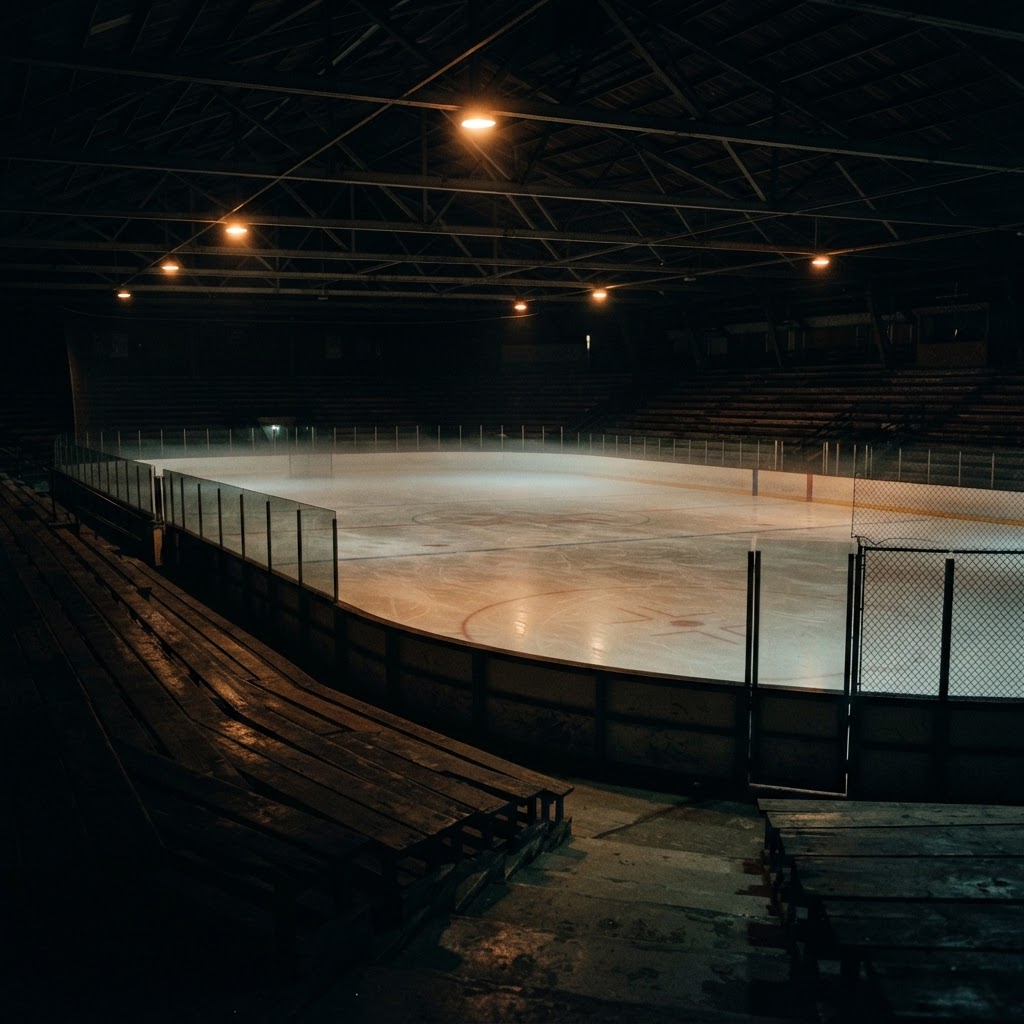
There's a version of hockey history that gets told in trophy cases and record books. Gretzky's points. The '72 Summit Series. The Miracle on Ice. These are the monuments, and the monuments matter. But the real shape of the game — the reason it moves the way it moves, the reason it feels the way it feels — that was carved out in back rooms and emergency meetings and split-second decisions that nobody remembers anymore.
Every rule in hockey exists because something went wrong. Every line on the ice has a story behind it. The sport wasn't designed. It evolved. And the people who were there for the pivotal moments mostly didn't know they were standing in one.
That's what makes hockey history interesting. Not the highlights. The hinges.
The Forward Pass Changed Everything — And Almost Didn't Happen
For the first few decades of organized hockey, you couldn't pass the puck forward. Full stop. The game was a possession grind — skate with it, protect it, muscle through. More rugby on ice than the sport we recognize today.
The forward pass was legalized in stages during the late 1920s, but only within zones. The NHL allowed forward passing in the defensive and neutral zones in 1927, and then — after watching the game open up — extended it to the attacking zone in 1929. The league didn't commit to it cleanly. They tested it, watched what happened, debated it.
What happened was: the game exploded. Scoring jumped. Movement changed. The geometry of hockey — the angles, the passing lanes, the way players think about ice — all of it traces back to that decision. Before it, hockey was a different sport wearing the same jersey.
If that rule change doesn't happen, or happens differently, you don't get the breakout pass. You don't get the stretch play. The whole tactical language of the game — everything a coach diagrams on a whiteboard — doesn't exist. It's almost impossible to overstate how foundational it was, which is exactly why nobody talks about it.
The Red Line Was a Wartime Compromise That Outlasted the War by Sixty Years
The center red line was introduced in 1943. The reason? The NHL was trying to speed up a game that had gotten defensive and slow. The compromise — allowing forward passes across the center line — opened up the neutral zone and gave teams a way to push pace without giving defenders too much time to set up.
It worked. For a while.
By the 1990s and early 2000s, the red line had become a defensive weapon. Coaches figured out how to use the two-line pass rule — you couldn't pass from your own zone across the red line — to clog the neutral zone with bodies. Trap systems turned games into 1-0 slogs. The Dead Puck Era is remembered as some of the least watchable hockey in modern history, and the red line was at the center of it.
The NHL eliminated the two-line pass in 2005, after the lockout. The red line stayed, but its power was stripped. The game opened back up. Speed returned.
A rule introduced as a wartime fix in 1943 took sixty-two years to fully correct. That's hockey. Solutions become problems. Problems get legislated around. The sport carries its own history in its rulebook.
The Mask That Nobody Wanted to Wear
Jacques Plante put on a mask on November 1, 1959, after taking a shot to the face from Andy Bathgate that split his nose and cheek open. He told coach Toe Blake he wasn't going back out without it. Blake, who hated the mask and thought it would impair vision and make goalies look weak, had no backup. He let Plante wear it.
The Canadiens won that game. And the next. And the six after that.
Plante had actually been wearing a practice mask for years before this — he'd built prototypes, experimented, believed in the concept when nobody else did. But the hockey establishment resisted. Real goalies played bare-faced. That was the culture. Getting stitched up and getting back in the net was the job.
It took another decade-plus for masks to become universal. Gump Worsley, one of the last holdouts, didn't wear one regularly until the early 1970s. The resistance wasn't just stubbornness — it was identity. The bare-faced goalie was a kind of mythology, a statement about what the position meant.
Now it's unthinkable. The progression from Plante's crude fiberglass shell to the modern painted mask is one of the clearest through-lines in equipment history. But it started with one guy refusing to go back on the ice and a coach who had no choice but to let him.
The Summit Series Didn't Just Matter for Canada. It Redefined What the Game Was.
September 1972. Eight games, split between Canada and the Soviet Union. Canada nearly blew it completely, losing the first game 7-3 in Montreal in front of a country that had assumed this was going to be easy.
It wasn't easy. It was a crisis.
The Soviets played a style that Canadian hockey had spent decades dismissing — structured, conditioned, systematic. They cycled the puck. They trained like athletes in ways NHL players simply didn't. The Canadian approach was toughness, skill, and the assumption that pro hockey was the best hockey in the world by default.
The Summit Series exploded that assumption in a single period. Canada clawed back to win the series — Paul Henderson, the goal, the moment everyone knows — but the game that came back wasn't the same game that showed up in September. The series forced a reckoning with conditioning, systems, and international competition that reshaped how the NHL thought about the sport.
The influx of European players that defined the 1980s and beyond? It starts here. The evolution of skating and systems in the modern game? It starts here. The Summit Series isn't just a historical event. It's the moment hockey's self-image cracked open and something new got in.
The Lockout That Rewrote the Ice
The 2004-05 lockout cancelled an entire NHL season. It's remembered mostly for the labor battle, the bitterness, the lost year. But what came out the other side changed the physical game in ways that still echo.
The crackdown on obstruction and interference — the "new NHL" mandate — wasn't just enforcement. It changed how players were coached, how defenders were allowed to play, what constituted a penalty versus a hockey play. Hooking and holding calls that had been ignored for twenty years suddenly ended shifts.
Combine that with the elimination of the two-line pass and you had a game in 2005-06 that looked genuinely different from 2003-04. Faster. More open. Scoring went up sharply that first season before defenses adjusted.
The lockout also accelerated the analytical turn in hockey. Teams that had coasted on traditional scouting started looking harder at what the numbers actually said. The lost season gave front offices time to think. Some of them used it.
None of this was intended. The lockout was about money and control and leverage. The game changes that followed were byproducts, side effects, accidents of circumstance. Which is maybe the most honest way to describe how hockey has always evolved: not by plan, but by collision.
The Game Is a Palimpsest
A palimpsest is a manuscript where old writing has been scraped away and written over — but the old words still show through. Hockey is that. Every rule carries the ghost of the rule before it. Every line on the ice is someone's solution to a problem that might not even exist anymore.
When you watch a modern game — the speed, the structure, the equipment, the ice surface, the neutral zone play — you're watching two hundred years of argument made physical. Guys in cold arenas debating whether you could pass forward. Coaches refusing to let their goalies wear protection. A country realizing mid-series that they'd been wrong about themselves.
The game didn't arrive. It was fought for, piece by piece, by people who mostly thought they were just solving the problem in front of them.
That's the history worth knowing. Not the records. The decisions that didn't feel like history at the time.
From the Collection
If you carry the game with you everywhere, the Hard Around Heritage Tee was made for that. Available now at /product/472176454
Explore the drop →