
Your Legs Are Gone. You've Got Two Minutes Left. Now What?
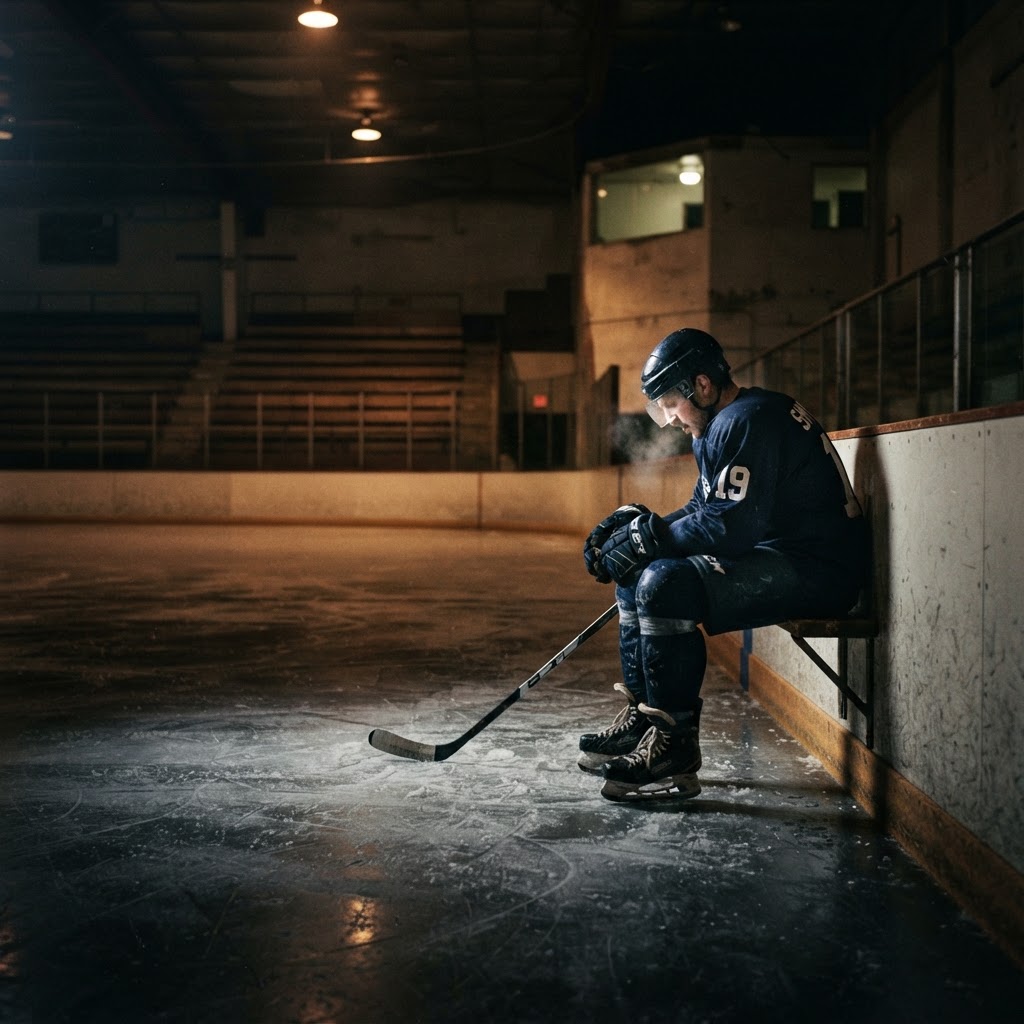
There's a moment in every hard game where the body stops cooperating. It's not dramatic. There's no snap, no pop, no obvious signal. One shift you're fine, the next shift your legs feel like wet concrete and your lungs are pulling air like a broken accordion. You know the moment. Every hockey player knows the moment.
The third period is where the game gets honest. Everything you did in the summer — the sprints, the squats, the early mornings on the bike — either shows up or it doesn't. But here's the thing nobody tells you at the start: fitness gets you to the door. What's on the other side of that door is something different entirely.
This is about that door.
What 'Hockey Fit' Actually Means (And Why Most People Get It Wrong)
Hockey fitness is not cardio fitness. It is not powerlifting fitness. It is not CrossFit fitness. It is its own strange animal — a combination of explosive short-burst power, sustained aerobic capacity, lateral mobility, and the ability to do all of that while wearing thirty pounds of gear on a slippery surface with people trying to separate you from the puck by any means necessary.
A marathon runner would be cooked in the first period. A sprinter might handle one line change before their legs seize up. What hockey demands is something in between and beyond both — repeated high-intensity efforts with incomplete recovery, shift after shift, for sixty minutes plus whatever hell the overtime gods decide to throw at you.
The physiologists call it 'intermittent high-intensity exercise.' Players call it 'getting your legs under you.' Both descriptions are accurate. Neither one captures what it actually feels like when you're deep in a third period, the score is tied, and your center is already back on the bench gulping air while you're still trying to make a play in the corner.
The mistake most recreational players make is training like athletes in other sports. They run. They lift. They feel good. Then they get on the ice in October and wonder why they're dying by the second period. The transition is brutal every single year, and no amount of dry-land fitness fully prepares you for that first month back. The ice is its own conditioning. There's no substitute for it.
The Shift Economy
Elite hockey is built around shifts of roughly 45 seconds to a minute. Beer league shifts run longer because lines are shorter and nobody blows the whistle when guys are gassed. Either way, the principle is the same: you go hard, you come off, you recover, you go again.
The recovery window is everything. Forty-five seconds on the bench sounds like nothing. It is nothing, if you're truly spent. Real recovery between shifts takes two to three minutes minimum for your phosphocreatine system to meaningfully reload. Most players don't get that. So the game becomes a slow accumulation of fatigue — a debt that starts small in the first period and comes due with interest in the third.
This is why shift management matters more than raw fitness for most players. Smart veterans who've lost a half-step have figured this out. They pace. They pick their battles. They don't chase pucks into the corner against a 22-year-old when the score is 4-1 in the second. They play the shift economy like a chess game, and by the third period they've got more left than the guy who was burning it all down every forty-five seconds trying to look impressive.
The young guys learn this the hard way. Usually somewhere around the ten-minute mark of the third, when the legs go and the panic sets in, and they realize the shift economy has them completely broke.
Mobility Is the Thing Everyone Ignores Until They Can't Ignore It Anymore
Strength and cardio get all the attention. Mobility gets none — right up until the moment your hip flexors stage a revolt mid-season and you're skating like a 70-year-old shuffleboard player.
Hockey is one of the most mobility-demanding sports on earth and it gets zero credit for it. The skating stride alone requires hip extension that most adults have completely lost from sitting at desks for eight hours a day. Add in the rotational demands of shooting, the lateral demands of edgework, the crouched athletic stance that you hold for entire shifts — your body is doing things in hockey that it does nowhere else in normal life.
The guys who stay on the ice into their 40s and beyond are almost universally the ones who figured out mobility work before their bodies forced the issue. Not yoga in the trendy sense — though that's not a bad thing — but targeted, intentional work on hips, thoracic spine, ankles, and groin. The unglamorous stuff. The stuff you do on a mat in your basement while some television show plays in the background.
Professional players have entire support staffs dedicated to keeping their bodies moving correctly. Everyone else has a foam roller they bought three years ago that mostly lives under the bed. The gap between those two realities shows up in the third period, and it shows up in the weeks after a hard game when recreational players can barely walk down stairs.
Skating Endurance Is Built in the Dark
The on-ice fitness work that actually moves the needle is almost never the fun stuff. It's not the skill sessions, not the scrimmages, not the power skating clinics where you work on your crossovers for an hour. It's the brutal, unglamorous conditioning skates — the ones where you go hard until you can't, and then you go again.
Suicides. Stops and starts. Repeat sprints from goal line to blue line to red line to blue line to goal line, over and over, until the ice shavings are piling up at the boards and your jersey is soaked through the shoulders. These are the sessions players dread and the sessions that build the engine.
The best conditioning comes from actually playing — from ice time that pushes you past comfort repeatedly. But not everyone has that luxury. Adult rec players steal ice when they can get it. Junior players grind through team practices and then go find more. The ones who build real skating endurance are the ones putting in time that nobody sees, on ice surfaces that aren't glamorous, at hours that don't fit a normal schedule.
There's a reason the old phrase is 'built in the dark.' The fitness work that changes your third period doesn't happen under bright lights. It happens in empty arenas at 6am, in parking lot rollerblading sessions in July, in basement stairwell circuits that make the neighbors wonder what's wrong with you. It accumulates quietly and shows up loudly when the game needs it.
When the Legs Go, the Brain Takes Over
Here's what the fitness conversation always misses: at a certain point, when you've done the work and you're still cooked in the third period — because you will be, at some level, in every game that actually matters — the rest is mental.
Fatigue changes your decision-making before it changes your skating. The brain starts looking for reasons to ease off. It starts suggesting that the puck race isn't worth it, that someone else can cover the point, that taking a bad angle on the backcheck is fine. The mental erosion comes before the physical collapse.
The players who are dangerous in the third period aren't always the best-conditioned players. Sometimes they're just the ones who are most committed to continuing to make the right play when every system in their body is arguing for shortcuts. That stubbornness — the refusal to let fatigue dictate decisions — is not something you build in the gym. It's built by pushing through situations where quitting would be easier. By staying on shifts that hurt. By taking the hard route on the backcheck when the easy route is right there.
The third period reveals character because it strips away everything comfortable. The fitness either holds or it doesn't. But underneath the fitness, underneath the legs and the lungs, there's something that either shows up or doesn't — and it has been building or eroding since long before puck drop.
That's the honest thing about hockey fitness. The physical work matters enormously. And then, at the worst possible moment, it stops being about the physical work entirely.
From the Collection
The Hard Around Tee is built for people who put in the work nobody sees. Available now at /product/472048340.
Explore the drop →