
the ritual is the point. the game is almost secondary.
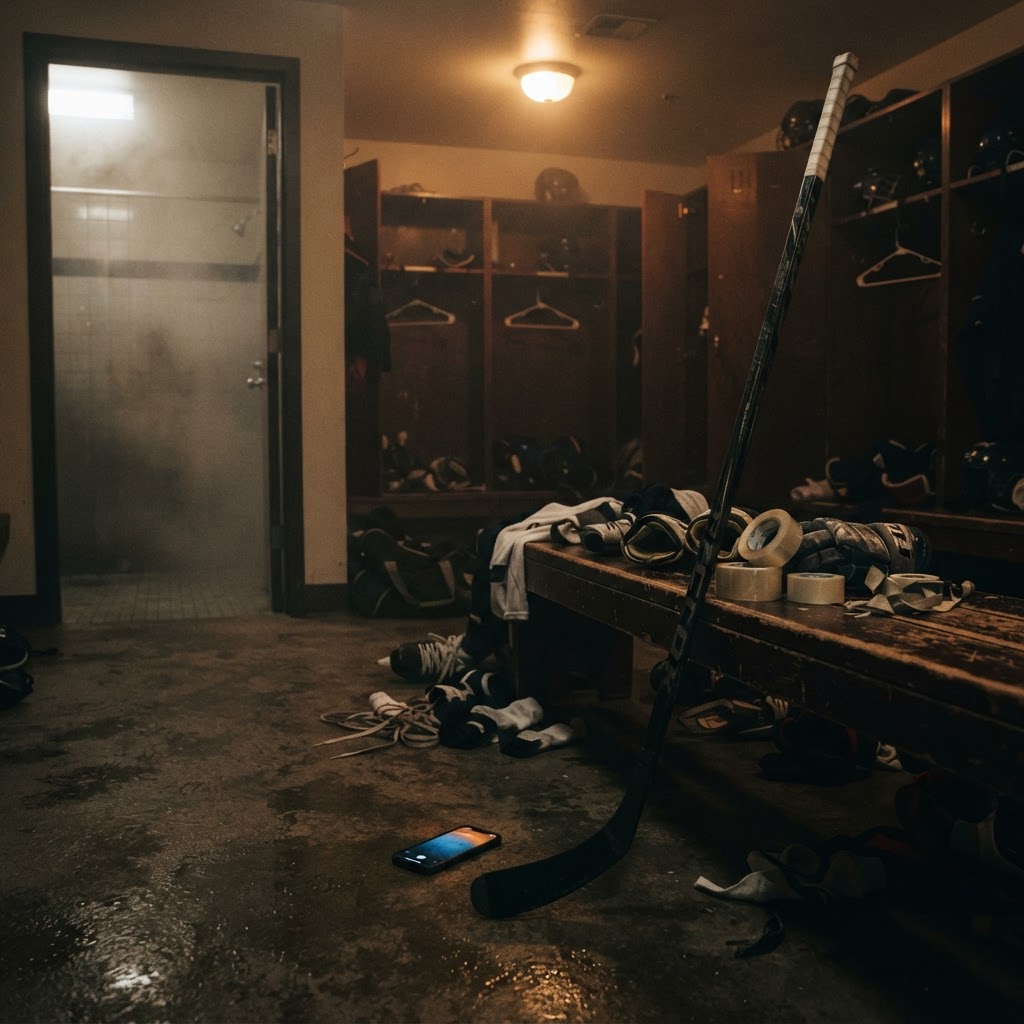
There's a guy in every dressing room who puts his gear on in the exact same order every single game. Left shin pad, right shin pad, left skate, right skate. Always. You could set a clock by him. Interrupt the sequence — even accidentally — and he'll start over. Completely. No apology needed. Everyone understands.
This isn't superstition in the way outsiders use the word, with that slight smirk, like it's something to grow out of. This is architecture. This is the scaffolding a player builds around the chaos of competition. Hockey is unpredictable in ways that no amount of preparation can fully neutralize. The ice does what it wants. Bounces defy physics. Refs see what they see. Against all of that randomness, the ritual is the one thing you control absolutely.
The game is almost secondary. The ritual is the point.
the stick that cannot be replaced
Every serious hockey player has had a stick they couldn't let go of. Not because it was the best stick they'd ever used — maybe it wasn't, technically. But it had something. A few tape jobs deep into its life, a slight warp in the shaft that actually felt right, a curve worn to the exact angle of your shot.
You know the stick is cooked. Your buddies are telling you the stick is cooked. You can hear it flexing wrong. But you keep taping it, keep reinforcing the blade, keep doing whatever ritual maintenance it takes to keep the thing alive because something good happened with that stick and you are not about to tempt fate by swapping it out.
Pro players are worse. Wayne Gretzky used to put baby powder on the blade of his stick before every game. Not for grip, not for performance — just because that's what you did. Patrick Kane has famously cycled through obsessive stick rituals for years. The gear itself becomes sacred, separate from its function.
At the beer league level, it's the same psychology wrapped in cheaper materials. The guy who refuses to break out the new Bauer he bought in October because his old composite is still technically one piece. One piece. Barely. But one.
what tape tells you about a person
How a player tapes their stick is one of the most personal things in hockey. It sounds like a stretch until you've spent enough time around dressing rooms. Then it's obvious.
Some guys do a candy-cane spiral that has to be perfectly even or they're pulling it all off and starting again. Some guys go full blade coverage, white only, no exceptions. Some guys barely tape at all — just a knob at the top and a couple wraps at the toe — and they've been doing it that way since they were twelve and they will be doing it that way when they're sixty.
The ritual of taping isn't really about the tape job. It's meditative. It's the transition from the civilian world into hockey mode. When your hands are working through a familiar pattern, your brain is shifting gears. The commute, the work stress, the argument you had at home — it's getting crowded out by the smell of a dressing room and the feel of tape in your hands. The tape job is the door between the life outside and the game.
Mess with someone's tape and you're messing with more than equipment. You're disrupting a ceremony.
the playoff beard as collective ritual
The playoff beard gets talked about like it's just a hockey tradition — something fun, a bit of folklore, a reason for players to look increasingly feral through June. But it's actually one of the purest examples of collective ritual in all of professional sports.
The individual superstition scales up into something the whole team participates in. Nobody shaves. It started as a personal thing — players didn't want to change anything when the team was winning — and it became a synchronized act of shared belief. The beard isn't about luck in any literal sense. It's about unity through shared sacrifice and shared weirdness. We're all in this together and here's our visible proof.
At the amateur level, playoff beards get taken just as seriously. Beer leaguers who can barely grow a full beard will refuse to shave during a playoff run that spans three weeks and four games. The attempt is the point. The commitment to the bit, to the collective ritual, is the point. You look like a teenager trying to impress someone and you don't care, because you're doing it with your teammates and the team is still alive.
When the team loses and the beards come off, there's a small grief in that too. The ritual ends. The season ends. Both at once.
the route that cannot change
A lot of players have a pre-game route. The specific order they drive or walk to the rink. The exact place they park. The door they enter through. Some guys have a specific song that has to be playing when they lace up — not just any song, that song — and if someone's aux cord game goes sideways and the playlist gets disrupted, there's a palpable tension in the room.
This extends into the warmup. The exact number of laps. The shots you take from specific spots on the ice before you feel ready. The way you tap the posts. Goalies tap their posts with ritualistic precision — that's well documented — but skaters do it too, just less famously. The tap is a greeting, an acknowledgment, a small prayer to the geometry of the net.
Some guys have food rituals. The exact meal, the exact timing. Sidney Crosby's pre-game meal routines are legendary in hockey circles. But you don't need to be Crosby for it to matter. The guy in your Monday night rec league who always eats the same thing on game day and gets legitimately anxious when circumstances force a change — that's the same instinct operating at the same depth. The scale is different. The need is identical.
when the ritual fails
Here's what nobody talks about much: what happens when the ritual fails. When you did everything right — every step in order, every tape job perfect, the right socks, the right song, the right meal — and you still got smoked 6-1 and played the worst game of the season.
This is actually where superstition gets philosophically interesting. Because most players don't abandon the ritual after a bad result. They either add to it — something must have been slightly off, so they adjust, refine, add a new element — or they double down completely, convinced the failure was anomalous and the ritual is still sound.
Very few players look at a ritual-plus-bad-result and conclude the ritual is meaningless. Because the ritual was never really about the result. It was about the feeling of readiness. It was about having something to hold onto in the minutes before the game when your body is full of adrenaline and your brain needs something to do. The ritual gives the anxiety somewhere to go.
When the ritual fails to produce a win, it still produced the feeling of being prepared. That's what it was always for.
passing it down
The deepest thing about hockey rituals is how they travel. Kids pick up superstitions from older players. Younger players on a team absorb the rituals of veterans just by being in the same dressing room long enough. A specific way of doing something gets copied, modified, made personal, and then passed down again.
Nobody teaches these things formally. Nobody sits a kid down and explains why you tap the posts or why you dress in a specific order or why you never compliment someone on a shutout before the third period ends. You absorb it. You watch and you learn and eventually you just know, the way you know every other unwritten rule of hockey culture.
The rituals are part of what makes this game feel like more than a game. They're a through-line connecting every generation of players who've ever pulled on gear and needed to believe, for two hours on a Tuesday night or a Saturday afternoon, that they had some small measure of control over what was about to happen on the ice.
They didn't. Neither do you. But the ritual helps. It always helps.
From the Collection
The Hard Around Red Tee carries that same energy — worn in, deliberate, nothing extra. Part of the permanent collection at /product/472276833.
Explore the drop →