
You Already Speak the Language. You Just Don't Know Where It Came From.
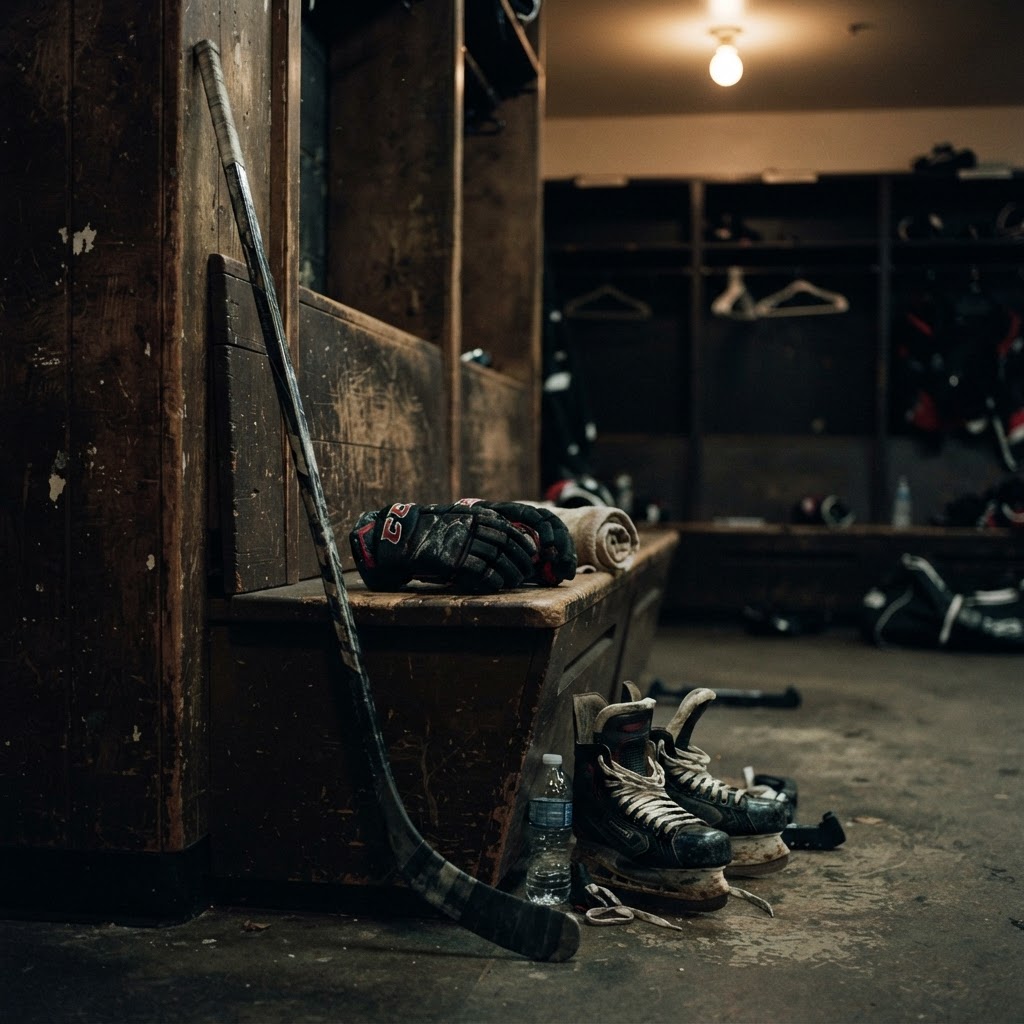
There's a moment, usually somewhere around your second or third season, when you stop translating.
You hear *biscuit* and you don't think bread. You hear *barn* and you don't picture a farm. Someone says a guy's got *mitts* and you already know they're not talking about winter gear. The language just lands — direct, immediate, no processing required. You're inside it. You belong to it now.
Hockey has one of the richest unofficial vocabularies in all of sport. Not the sanitized broadcast language — not the stuff analysts say on television between highlights. The real thing. The stuff that lives in dressing rooms and on benches and in the parking lot at midnight after a game that went sideways. The words that got passed down rink to rink, city to city, generation to generation, with zero documentation and zero intention of ever being explained to anyone who wasn't already there.
This is an attempt to explain it anyway.
The Puck Has Never Been Just a Puck
Start with *biscuit*. It's the most basic one, the gateway drug into hockey vernacular. A frozen vulcanized rubber disc becomes a biscuit. Why? Nobody actually knows. The theory that floats around most often is that early pucks looked like hardtack biscuits — those dense, flat bread rounds that kept forever and tasted like regret. Plausible. Probably true enough.
But the more interesting thing about *biscuit* isn't its origin. It's what it tells you about hockey culture. The game takes a piece of equipment — the most essential piece, the entire point of the exercise — and gives it a ridiculous, warm, slightly absurd nickname. That's not an accident. That's a culture that refuses to take itself too seriously even when it's taking the game completely seriously. The puck is sacred. The puck is also a biscuit. Both things are true.
Same goes for *twine* (the net), *pipe* (the post), *barn* (the arena). These aren't technical terms. They're affectionate ones. A barn isn't just a building with ice in it — it's a specific kind of place. Cold air and low ceilings and that particular sound the crowd makes in a small rink when something good happens. You can feel what a barn is before you've ever heard the word defined. The slang is doing emotional work that official language can't.
What a Celly Actually Says About You
The *celly* — the goal celebration — is where hockey slang gets genuinely revealing.
Every sport has goal celebrations. Hockey's relationship with them is uniquely complicated. There's an entire unwritten code governing when a big celly is acceptable, when it's asking for trouble, and when it crosses a line that will get remembered until the next time these two teams meet. Scoring on your former team? Keep it quiet. Up six goals in the third? Maybe holster it. Overtime winner in a playoff game? Lose your mind. The ice is yours.
The word *celly* itself is almost deliberately understated — a clipped, casual shortening of *celebration* that drains the drama out of it. Which is very hockey. The thing you're describing (grown adults losing complete composure, jumping on each other, screaming into the rafters) gets a two-syllable word that sounds like something you'd say about going out for lunch. The language keeps the emotion contained even when the emotion absolutely is not.
And then there's the vocabulary around *not* celebrating — the guys who score and just point at the guy who passed to them, or tap the post and skate back to the bench like they've done this a thousand times. In hockey culture, that restraint has its own kind of prestige. The celly matters. The decision not to celly matters just as much.
Beauty, Bender, and the Character Assessment System
Hockey has developed what might be the most efficient character assessment vocabulary of any subculture on earth.
*Beauty* is the top of the mountain. It's not about skill — that's important to understand. A beauty isn't necessarily the best player in the room. A beauty is someone who is fully, completely, authentically themselves in a way that the room recognizes and respects. The guy who chirps perfectly, who picks up the tab without making it a thing, who has a story for every situation, who plays hard every shift and doesn't need anyone to notice. That's a beauty. The word is doing serious cultural heavy lifting in four letters.
*Bender* is, famously, the opposite end of the spectrum. The etymology here is actually straightforward — a bender is someone whose ankles bend inward when they skate, a telltale sign of someone who didn't come up through serious hockey. But like most hockey slang, it evolved beyond its literal meaning. A bender now describes a certain combination of poor skating, questionable decisions, and an inability to read the room that extends well beyond the ice surface. You can be a bender off skates. It's a full-person assessment.
In between you've got *plugs* (guys who work hard, don't have a lot of skill, no one's quite sure how they're on the team but you respect the commitment), *snipers* (doesn't have to do much, just finds the net with alarming regularity), and *grinders* (the engine room, does the work no one films). Each word is a complete scouting report. Each one places a player precisely in the ecosystem of a roster. The vocabulary creates a taxonomy of hockey humanity that everyone who's played the game can immediately map onto people they've played with.
The Apple and the Art of Passing Credit
Most sports don't have dedicated slang for the assist. Hockey has *apple*.
This matters more than it might seem. In a culture that worships goal-scorers, the fact that there's affectionate, distinctive slang for the assist is quietly significant. The guy who threads the pass through four defenders and puts the puck on a tape-to-tape for an easy finish — he gets an apple. The guy who started the play from behind his own net, made two passes, and created the whole thing — he gets an apple too. They all count the same.
The word itself is cheerful and a little random, which is very on-brand for hockey vocabulary. No one's entirely sure where it came from. Some trace it to the shape of the letter 'A' that shows up in the box score next to an assist. Some think it came from the phrase *she's a beauty* being shortened and morphed over decades of dressing room telephone. Either way, it stuck. It became the word. And now when someone says they picked up two apples in a beer league game on a Tuesday night, there's a whole feeling attached to that — the particular satisfaction of setting someone else up, of being the one who saw the play before it happened.
Dangle, Snipe, Celly: The Holy Trinity
If you've been around hockey for any length of time, you've heard the phrase: *dangle, snipe, celly*. It shows up on t-shirts and in comment sections and in the kind of videos where someone does something absurd in a skills competition.
What's interesting is how precisely that three-word sequence captures the ideal hockey moment. The *dangle* — the move, the stickhandling that leaves a defender reaching at air — is about individual skill and creativity. The *snipe* — the precise, hard shot that finds a corner — is about execution under pressure. The *celly* is about release, about the emotional payoff that follows doing something difficult well in front of other people.
Together they tell a story. Not just about a goal, but about what hockey players value. The creativity comes first. Then the precision. Then — and only then — the feeling. The sequence matters. You can't snipe without first getting to a place where a snipe is possible. You can't celly authentically if the snipe was lucky. The whole framework is about process leading to outcome leading to deserved joy.
That's a pretty good philosophy for most things, actually. Hockey figured it out and gave it three words.
The Language Is the Culture
Here's the thing about hockey slang that doesn't get said enough: it's not really about vocabulary. It's about belonging.
When someone new shows up in a dressing room and uses the words right — when they say *barn* and *biscuit* and *beauty* with the correct weight and timing and context — the room knows something about them before they've said anything else. They've been around. They get it. The language is a signal, and the signal is legible.
And when someone gets it wrong — when they oversell a celly after a garbage goal against a beer league team that's down four skaters, when they call someone a beauty and it lands hollow — the room knows that too.
You don't learn this vocabulary from a glossary. You learn it the way you learn everything worth knowing about hockey: by being in rooms, logging time, paying attention to what the guys who've been around longer than you do and say and don't say. The slang is alive because it's transmitted person to person, rink to rink, generation to generation.
It's one of the things that makes hockey, hockey. The language doesn't just describe the culture. It *is* the culture. And once you're inside it, it's impossible to imagine talking about the game any other way.
From the Collection
The Hard Around collection is built for people who already know what beauty means. Shop at /product/472182765
Explore the drop →